
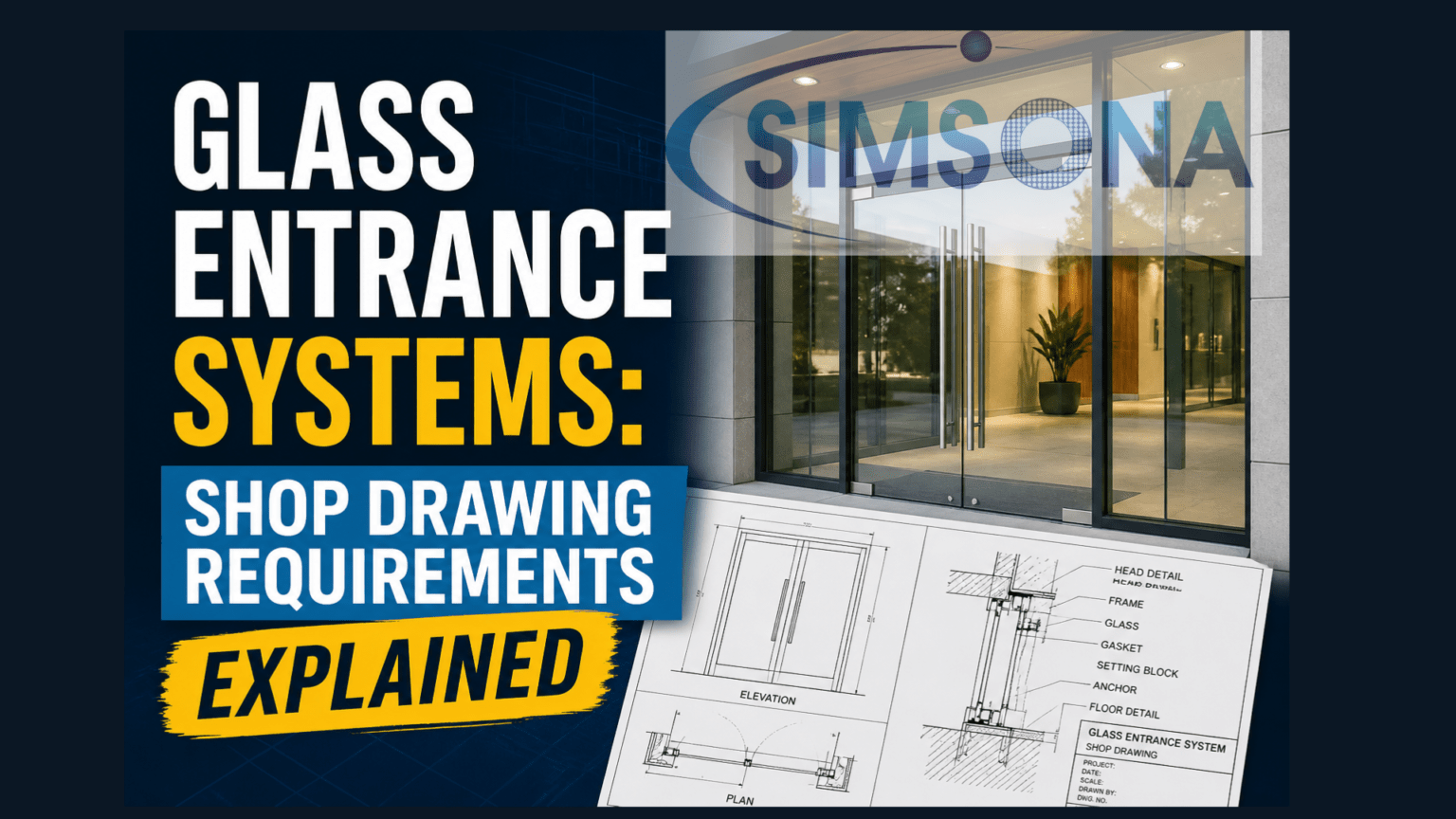
Glass entrance systems are one of the most visually striking and functionally critical elements in modern architecture. From commercial office towers and retail stores to airports and institutional buildings, glass entrances create a seamless connection between exterior and interior spaces while ensuring durability, safety, and performance. However, behind every flawless glass entrance lies a detailed shop drawings.
Shop drawings are the backbone of accurate fabrication and installation. Without them, even the most well-designed glass entrance can suffer from misalignment, structural issues, or costly rework.
What Are Glass Entrance Systems?
Glass entrance systems are architectural door and entryway solutions primarily made of glass, designed to provide both functionality and visual appeal in buildings. These systems typically include components such as glass doors (sliding, swing, or revolving), sidelights, transoms, framing (aluminum or frameless), and hardware like hinges, handles, and locking mechanisms.
They are widely used in commercial spaces such as offices, malls, airports, and hotels, as well as in modern residential designs. One of their key advantages is transparency, which allows natural light to flow into interiors, creating a bright and welcoming environment.
What Are Shop Drawings?
Shop drawings are detailed, fabrication-level drawings prepared by contractors or specialized detailing firms. Unlike design drawings, which show conceptual intent, shop drawings provide exact dimensions, materials, connections, and installation details.
For glass entrance systems, shop drawings ensure:
Accurate fabrication of glass panels and frames.
Proper coordination with structural and architectural elements.
Compliance with safety codes and standards.
Smooth on-site installation.
Why Are Shop Drawings Critical for Glass Entrance Systems?
Shop drawings are critical for glass entrance systems because they translate design intent into precise, buildable details. Unlike general architectural drawings, shop drawings provide exact dimensions, material specifications, fabrication details, and installation guidelines tailored to the specific project conditions. This level of detail is essential for glass systems, where even minor inaccuracies can lead to misalignment, safety risks, or costly rework.
Glass entrance systems often involve components such as tempered or laminated glass panels, aluminum frames, patch fittings, hinges, and locking mechanisms. Shop drawings clearly illustrate how these elements fit together, ensuring proper coordination between architects, engineers, fabricators, and installers. They also account for tolerances, load requirements, and compliance with safety standards, which is crucial for structural stability and user safety.
Key Components Covered in Shop Drawings
A complete glass entrance system shop drawing includes multiple components:
1. General Arrangement Drawings
These drawings show:
Overall layout of the entrance system
Location within the building.
Dimensions (height, width, clear opening).
Relationship with adjacent walls and façade.
They act as a reference for all other detailed drawings.
2. Plan, Elevation, and Section Views
These are essential views included in shop drawings:
Plan View: Shows door swing direction, clearances, and positioning.
Elevation View: Displays the front look of the entrance.
Section View: Provides cross-sectional details of frames, glass thickness, and joints.
Each view ensures that no ambiguity remains during fabrication or installation.
3. Glass Specifications
Glass is the most critical component, and shop drawings must clearly define:
Type of glass (tempered, laminated, insulated).
Thickness (e.g., 10mm, 12mm, or IGU units).
Safety requirements (impact-resistant, fire-rated).
Edge finishes (polished, beveled).
Coatings (low-E, tinted, reflective).
An incorrect glass specification can compromise both safety and performance.
4. Framing and Support Systems
Depending on the design, the system may include:
Aluminum frames.
Steel frames.
Frameless glass systems (patch fittings or spider fittings).
Shop drawings must detail:
Frame profiles and dimensions.
Material finishes (anodized, powder-coated).
Fixing methods to the building structure.
Expansion allowances.
5. Door Hardware Details
Glass entrance systems rely heavily on hardware for functionality. Shop drawings must include:
Hinges (pivot hinges, floor springs).
Handles and pull bars.
Locking mechanisms.
Door closers.
Access control systems (if applicable).
Each hardware element must be accurately located and coordinated with glass cutouts.
6. Connection and Fixing Details
This is one of the most technical parts of shop drawings. It includes:
Anchor locations.
Bolt sizes and types.
Connection to structural elements (concrete, steel).
Sealants and gaskets.
Proper detailing ensures that the system can handle loads such as:
Wind pressure.
Door usage loads.
Thermal expansion.
7. Tolerances and Clearances
Shop drawings must clearly define allowable tolerances for:
Glass installation gaps.
Frame alignment.
Door operation clearance.
Typical considerations include:
Expansion gaps.
Floor level variations.
Structural movement.
Ignoring tolerances can result in binding doors or glass stress cracks.
8. Weatherproofing and Sealing Details
Glass entrances must prevent:
Water infiltration
Air leakage
Shop drawings include:
Sealant types and locations
Gasket details
Drainage provisions
This is especially important for external entrances exposed to weather.
9. Compliance with Codes and Standards
Shop drawings must adhere to relevant codes such as:
Safety glazing standards
Fire safety regulations
Accessibility standards (like door width and opening force)
Compliance ensures that the system is legally approved and safe for public use.
Conclusion
Glass entrance systems are more than just architectural features—they are complex assemblies that demand precision, coordination, and technical expertise. Shop drawings play a crucial role in translating design intent into reality by providing detailed instructions for fabrication and installation.
From glass specifications and hardware detailing to structural connections and weatherproofing, every element must be carefully documented. A well-prepared shop drawing not only ensures smooth execution but also prevents costly errors and enhances the overall performance of the system.
 301-774-0880